AI assistant for job search: built for targeted applications and recruiter outreach
Jobifer helps experienced job seekers turn scattered job boards, repeated CV edits, and cold outreach into one focused workflow built around fit, timing, and direct signal.
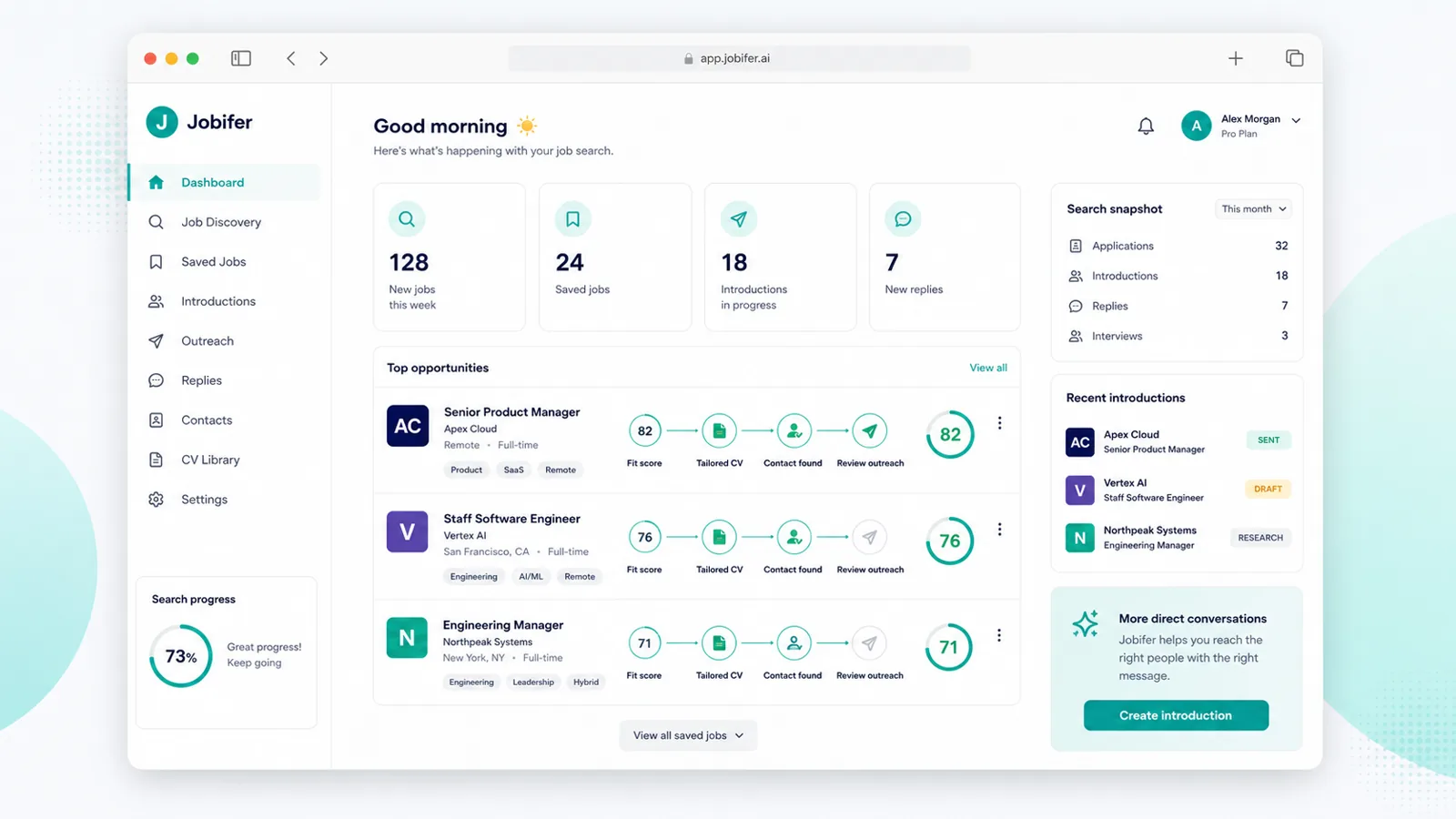
A targeted job search workspace: opportunities, fit signals, tailored materials, contacts, and outreach status in one view.
Why it matters
Make AI assistant for job search useful in the real job search workflow.
What an AI assistant for job search should actually do
A useful assistant should not simply generate cover letters or push more applications into crowded portals. Jobifer is designed to search across major job platforms and direct company career sites, filter harder, tailor your materials, and reach the people connected to the role. Most tools marketed as an automated job search assistant focus on volume. Jobifer focuses on whether the role is worth your time in the first place.
Built for targeted job search, not mass applying
Jobifer prioritizes fit and control. It identifies roles worth your attention, prepares materials around the specific opportunity, and keeps outbound messages under your review before anything is sent. Sending fewer, better-matched applications consistently outperforms blasting out generic ones.
One workflow from discovery to outreach
Instead of juggling job boards, documents, spreadsheets, and inbox tabs, Jobifer keeps discovery, CV tailoring, contact research, and outreach preparation in one workspace. This is what separates a genuine AI job search tool from a writing assistant that happens to know job-search vocabulary.
These are the kinds of repeatable job-search moments where Jobifer is meant to add structure, context, and speed without making the search generic.
A senior product manager can compare high-fit roles, prepare a role-specific CV, and approve a recruiter introduction from the same workspace.
A software engineer can avoid low-fit postings by reviewing fit signals before spending time on a custom application.
A candidate returning to the market after a break can turn a broad profile into a short list of roles, materials, and next actions.
A remote-first job seeker can keep location, seniority, compensation, and company context visible while deciding what deserves attention.
How it works
A workflow built around decisions, materials, people, and follow-up.
1
Set the target
Start with your profile, target roles, locations, seniority, and search preferences, so Jobifer has useful context to work from.
2
Review better-fit roles
Use fit scoring and job context to decide which opportunities deserve tailoring and outreach, rather than treating every posting the same.
3
Prepare the package
Create a tailored CV, identify relevant hiring contacts, and draft a focused introduction for review before anything goes out.
4
Track what happens next
Keep saved roles, sent outreach, and next steps connected instead of spread across tabs.
Use cases
Where Jobifer fits.
Jobifer is built for targeted searches where better fit, cleaner materials, and direct outreach matter more than raw application volume.
Finding roles that match your seniority, location, and target function
Turning a saved role into a tailored CV and introduction
Preparing recruiter or hiring-manager outreach you can review before sending
Tracking the jobs, people, and conversations that matter
Comparison
Different from a generic AI writing tool
A generic writing assistant can draft text, but it has no idea which role, CV, contact, and outreach draft belong together. Jobifer is built around the job-search workflow itself, not just the documents that come out of it.
Opportunity discovery and fit scoring come before writing
Tailored CVs stay connected to specific roles
Outreach remains approval-first and tied to contacts
Sent introductions stay attached to the opportunity
Differentiation
Why Jobifer is not just another generic AI job tool.
It focuses on targeted search quality instead of raw application volume - among the best AI job search tools, this is usually the line that separates the useful ones from the noisy ones.
It combines discovery, CV tailoring, contact research, outreach, and tracking in a single place.
It keeps the candidate in control of final sends and decisions at every step.
It works as a system of record for the search, not just a text generator - which is the gap most candidates run into when they try a best AI job search app built around chat alone.
If you're evaluating an AI assistant for job search and want something that actually understands how a real search moves from a saved listing to a sent introduction, that's the problem Jobifer was built to solve.
Questions
Common questions about ai assistant for job search.
Is Jobifer only for applying faster?
No. The goal is not volume for its own sake. Jobifer helps you find better opportunities, tailor your materials, and reach relevant contacts with higher-signal outreach.
Does Jobifer send messages automatically?
Jobifer prepares outreach for review. You stay in control of what gets sent and when.
What should I look for in an AI job search assistant?
Look for fit screening, role-specific materials, contact-aware outreach, review controls, and tracking. A tool that only produces generic cover letters will not solve the whole search workflow.
Can Jobifer help with senior or niche searches?
Yes. Jobifer is especially useful when fit, positioning, and direct outreach matter more than submitting a large number of generic applications.
How is Jobifer different from an AI resume builder?
Resume builders focus on the document. Jobifer connects the document to the role, contact research, outreach, and follow-up workflow.